
Putnam County Projected Release Dates
Projected, tentative, current, scheduled, and actual are not interchangeable labels. Florida law calls FDC’s gain-time calculation a “tentative release date.” The public FDC active-inmate profile uses the exact screen label “Current Release Date.” A released profile instead uses “Release Date.” Copy the wording from the source because each label answers a different stage of the custody process.
A sentenced person can have a calculation based on the maximum sentence, lawful credit, and sentence structure. A pretrial detainee has not yet received that kind of sentence calculation. Bond payment, a judge’s order, dismissal, transfer, or another event may end the Putnam County Jail booking, but none creates a guaranteed projected jail date in the public roster.
Scheduled versus actual: An FDC Current Release Date is prospective. A PCSO released timestamp or an FDC Release Date records an exit already processed by that agency.
- Tentative release date
- FDC’s statutory projection from maximum sentence expiration and lawful gain-time adjustments.
- Current Release Date
- The prospective date label shown on an active FDC inmate profile.
- Release Date
- The date label on the FDC release profile after a state-custody exit is recorded.
- Detainer
- A claim or notice from another authority that can affect where a person goes when one custody ends.
Find Putnam County Release Dates
Use the person’s location and identifier to choose the path. The FDC Offender Search hub separates active inmates, inmate releases, supervised people, and absconders. FDC databases cover state prison and covered state supervision, not a person whose only sentence or stay was in Putnam County Jail.
- Identify the custodian. Check whether the person is in Putnam County Jail, Putnam Correctional Institution or another FDC prison, or a different system.
- For FDC custody, search Inmate Population by the six-character DC number. Read the exact “Current Release Date” field and review sentence and detainer information.
- For a county-jail sentence, copy the booking number and court case number. Ask PCSO Records for the current computation and the court for the sentence and credit orders.
- For a pretrial case, review the court docket for bond and release orders. Do not turn a hearing date into an exit date.
- Check holds, detainers, amended orders, and supervision or FCOR records. Then reconfirm with the agency that makes the calculation.
The FDC Inmate Population search is useful for a future date; the Inmate Release database covers people released or scheduled for release and is updated nightly. Name searches are begins-with. A DC number avoids many false matches. FDC says population data receive a full weekly refresh, except release-date and location changes that update nightly.
The active-detail image demonstrates the exact public label. View the official FDC example used for this image.
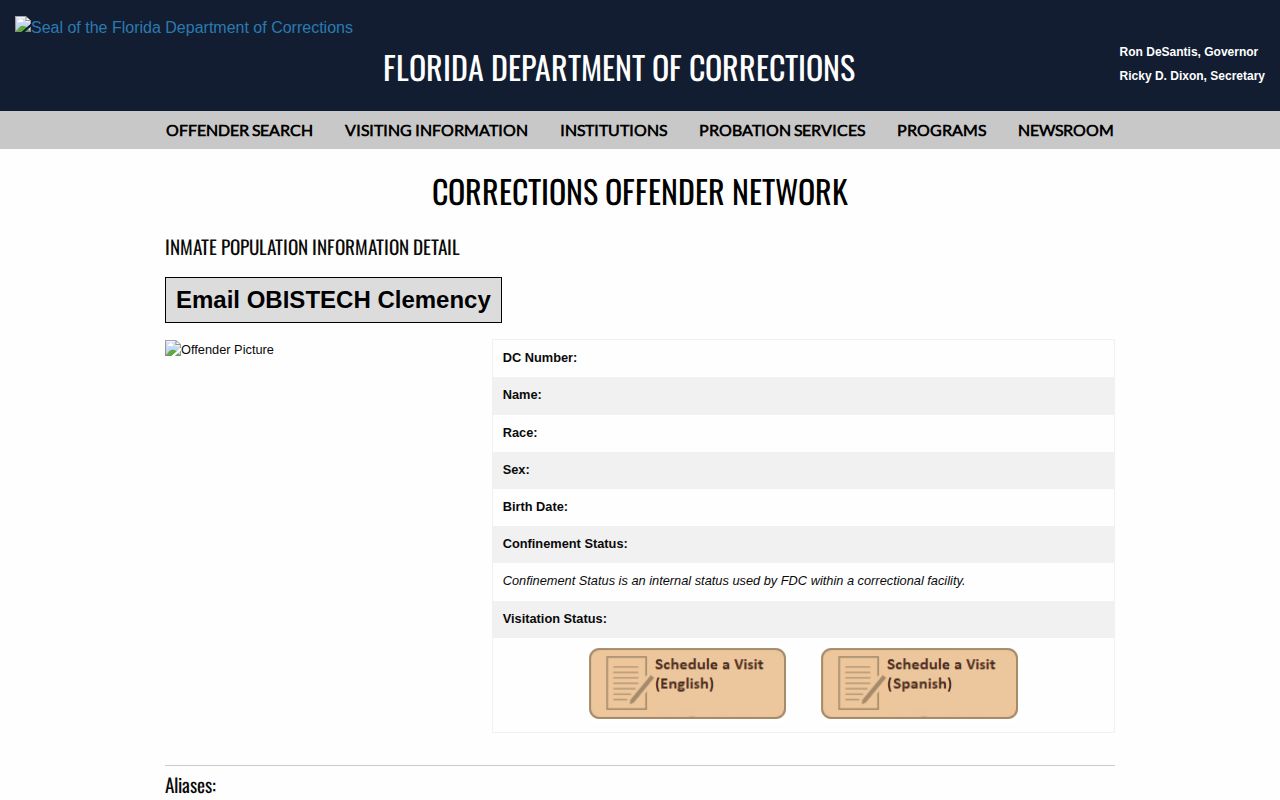
The profile’s “Current Release Date” should be reported as an FDC calculation, not a promise that release will occur at a particular hour or lead directly to the community.
Florida State Release Date Calculation
Florida Statutes section 944.275 starts with maximum sentence expiration and directs FDC to establish a tentative release date from gain time granted and forfeited. A new award or restoration can move the date earlier. A forfeiture can move it later, but not beyond maximum expiration. FDC, rather than the reader, applies the sentence structure, offense dates, court credit, and eligibility rules.
For offenses committed on or after October 1, 1995, the general incentive framework permits up to ten days per month, subject to statutory restrictions. The covered 85-percent rule bars gain-time awards from producing release before 85 percent of the imposed sentence has been served. Court-awarded credit for physical incarceration counts toward that threshold. Some offense types and dates have added exclusions, while a life sentence remains natural life absent pardon or clemency.
These limits make simple arithmetic unsafe. Older basic gain-time provisions are not a universal current credit. Consecutive terms, concurrent terms, jail credit, amended judgments, and ineligible offense categories can alter the result. The official FDC value is still prospective and can change when new information posts.
Sentence dates matter as much as sentence length. The statute’s general incentive terms and exclusions have changed across offense periods, so a credit described for one cohort may not govern another. Court-awarded time already spent in physical custody is also distinct from later incentive credit, even when both affect the final computation. Read the judgment and sentence history before asking FDC to explain the displayed value. That gives Admission and Release the offense date, term structure, and credited custody needed to address a suspected error.
Section 944.70 identifies state release mechanisms for covered crimes, including sentence expiration, expiration reduced by lawful gain time, clemency, conditional release, conditional medical release, and control release. The public date does not always name the mechanism. Request the FDC admission-and-release record when that distinction matters.
Note: FDC’s 85-percent rule belongs to covered state sentences and should never be copied onto a Putnam county-jail term.
Putnam County Jail Date Credits
County-prisoner credit has a separate legal source. Florida Statutes section 951.21 allows county commissioners to authorize deductions unless a majority discontinues or revises them. Its schedule permits up to five days per month in the first and second years, ten per month in the third and fourth years, and fifteen per month from the fifth year onward. It also permits an additional meritorious allowance of up to five days per month and allows forfeiture for misconduct.
No authoritative source in the Putnam research confirmed the exact current local policy or its application to an individual. Ask PCSO for the adopted policy and the jail’s computation. Also obtain the sentence and jail-credit orders from the Putnam court file. The statute’s maximum allowances are not proof that a named person received each credit.
| Custody | Calculation source | Where to confirm |
|---|---|---|
| FDC state prison | Section 944.275, sentence data, lawful gain time | FDC active profile and Bureau of Admission and Release |
| Sentenced Putnam jail | Court sentence, jail credit, section 951.21, adopted local policy | PCSO computation and Putnam court orders |
| Putnam pretrial detention | No fixed sentenced-inmate calculation | Court docket, bond or release order, and PCSO processing |
This county-versus-state split is the distinctive Putnam date issue. Both systems use credits, but the legal authority, agency, public fields, and verification route differ. Do not enter a Putnam jail sentence into an FDC-style formula.
Why Putnam County Release Dates Change
A future date can move when the source facts change. Some changes affect the sentence calculation. Others do not change the date but alter the next custodian or the actual exit time. The record should say which kind occurred.
| Factor | Possible effect | Best source |
|---|---|---|
| Gain-time award or restoration | May move an FDC tentative date earlier within legal limits | FDC calculation and section 944.275 |
| Gain-time forfeiture | May move a date later | FDC or county computation record |
| Amended court order | Can correct sentence length, structure, or jail credit | Filed court order |
| Concurrent or consecutive terms | Changes how multiple sentences operate | Judgment and agency calculation |
| Detainer or hold | May lead to transfer rather than community return | Custody and transfer records |
| FCOR action | May set, alter, delay, or revoke an eligible release action | FCOR final action or order |
| Processing and verification | Can affect actual exit time after legal authority arrives | Releasing facility |
FCOR’s public agenda is not a decision. Florida parole eligibility is narrow and primarily tied to legacy offense dates. If an eligible case appears on a voting agenda, request the final action sheet or order using the DC number and meeting date. Do not enter an agenda date as the projected release date.
FDC also warns that release information can change quickly. For a state computation, contact the Bureau of Admission and Release at 850-488-9167 or dc.release@fdc.myflorida.com. For a Putnam jail calculation, contact PCSO Records at 386-329-0822 and pair its information with the filed court record.
Putnam County Weekend Releases
No authoritative statewide or Putnam-specific rule was found that automatically moves a county-jail exit to Friday when the computed date falls on a weekend or holiday. PCSO publishes a processing schedule instead. Weekday releases are processed at 7:00 a.m., 3:00 p.m., 7:00 p.m., and midnight. Weekends and holidays remain on a 24-hour cycle.
The PCSO release schedule gives useful timing context, not an individual promise. A judge’s paperwork, identity checks, property work, other holds, and arrangements with a receiving custodian can affect the final timestamp. Call the jail for current instructions rather than planning around one published batch.
A court action date may therefore differ from the PCSO released timestamp. The former shows legal activity; the latter shows when that booking ended in the jail record. Keep both when an exact sequence matters.
The same caution applies to another agency’s hold. PCSO can finish its own release process and transfer the person to a different custodian. The county status then records the end of the Putnam booking, not an unrestricted return to the community. Ask for the transfer or destination record when a released timestamp appears but the expected person does not leave through ordinary local release arrangements.
Confirm Putnam County Release Dates
Near an expected state-prison release, recheck the active FDC profile by DC number and contact Admission and Release. After the event, search FDC Inmate Release for the “Release Date” and incarceration-history out date. Then check Supervised Population because prison release may lead to FDC supervision instead of full discharge.
Near a county-jail event, review the Putnam court docket for the controlling order and ask PCSO about the current calculation and other holds. Afterward, JAIL View can show “Status: Released” and the processed timestamp. It usually does not state release method or destination, so request those records when needed. The Putnam County released inmate records path explains that request and the court cross-check.
For formal state confirmation, the FDC public-records route accepts a full name, DC number, release period, and institution. Ask for the admission-and-release record, release date and type, facility, movement or incarceration history, and relevant calculation records. The public profile may show the date without naming whether the mechanism was sentence expiration, a gain-time-adjusted expiration, conditional release, or another authorized form. A focused request can preserve that distinction without turning a date field into an unsupported legal conclusion.
For event notice rather than computation, a Putnam County VINE inmate check can add an alert when the relevant agency participates. It does not replace the FDC calculation, PCSO timestamp, or court order. Confirm every alert with the record of the agency that held custody.
A sound answer states both source and stage: “FDC currently projects,” “the court ordered,” or “PCSO recorded release.” That phrasing preserves the difference between a date that may change and an exit that has already occurred.